
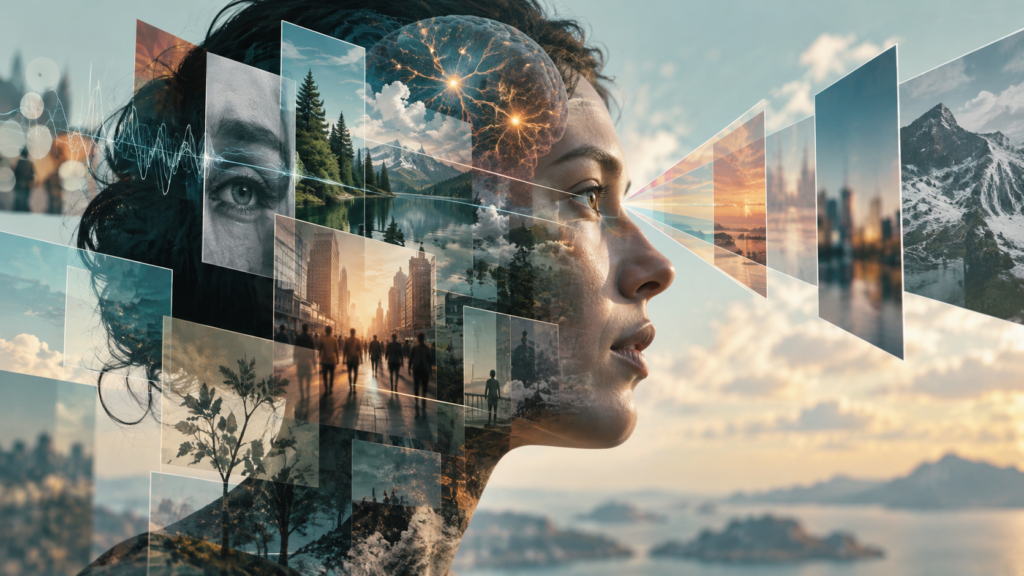
This article is adapted from the free Meruqel PDF Question Your Own Perception, a deeper exploration of how the brain constructs experience, how limited human senses shape our understanding of the world, and what may exist beyond the boundaries of ordinary perception.
You have never experienced reality directly. Everything you see, hear, smell, taste, and touch reaches you through biological systems that detect limited information and a brain that interprets what those signals mean. What you experience as reality is therefore not reality in its entirety. It is a version of reality assembled for you by your nervous system.
That raises an uncomfortable question: how much confidence should we place in the reality our minds present to us?
Your Brain Gives You a Version of Reality
We tend to think of perception as a window. We open our eyes, look at the world, and assume we are simply seeing what is there. But perception does not work that way. The brain receives incomplete sensory information, filters it, organizes it, compares it with previous experience, fills in missing pieces, and produces a coherent experience.
One of the simplest examples is the blind spot in human vision. Each eye contains an area where the optic nerve leaves the retina, creating a region with no light-sensitive cells at all. Yet under normal circumstances, you do not see a black hole floating in your visual field. Your brain fills in the missing information so smoothly that you are usually unaware anything is missing.
The reality you experience is already an interpretation. If the brain can routinely supply information that was never actually received, how much of ordinary experience is being constructed without our awareness?
Most of Reality Is Invisible to You
The limits do not stop with the brain. Human senses themselves detect only a narrow portion of what physically exists around us.
Our eyes respond to a limited range of electromagnetic radiation that we call visible light. Our ears detect only certain frequencies of sound. Yet other animals can perceive information humans cannot naturally experience. Bees can detect ultraviolet patterns. Some snakes sense infrared radiation. Bats navigate with ultrasonic sound. Various animals appear capable of detecting magnetic fields and polarized light.
These things are not imaginary simply because humans cannot perceive them.
Reality contains information that is completely real while remaining entirely outside normal human awareness. If we possessed different sensory organs, the same room, forest, city, or night sky might appear profoundly different from the world we know.
We often confuse the human experience of reality with reality itself.
Different Minds Can Occupy Different Worlds
Imagine a human, a bat, a bee, a snake, and a shark occupying the same general environment. Physically, they may inhabit the same world, yet each species detects different information and therefore experiences that environment in a very different way.
None necessarily possesses the complete picture. Each organism receives the portion of reality its biology allows it to detect.
Humans are no exception. Our perceptual world feels complete because it is the only one we have ever known. We rarely experience the boundaries of our senses as boundaries. We simply experience what we can perceive and call it the world.
That leaves a fascinating possibility. What aspects of reality might exist for which humans possess no perceptual equipment at all?
Certainty Is More Fragile Than It Feels
Even within our limited sensory range, perception is not always reliable. Expectations influence what we notice. Context changes how we interpret what we see and hear. Optical illusions reveal how confidently the brain can misinterpret visual information.
Memory introduces another layer of uncertainty. Human memory is not simply a recording stored untouched in the brain. Memories can be reconstructed, altered, blended with later information, and remembered with great confidence even when important details are wrong.
This does not mean reality itself is unreal, nor does it mean that nothing can be trusted. It means that certainty and accuracy are not always the same thing. An experience can feel completely convincing while our interpretation of it remains incomplete.
The Larger Mystery
If human senses detect only part of what exists, if the brain reconstructs incomplete information, and if other organisms perceive features of the environment that are entirely invisible to us, then one conclusion becomes difficult to avoid: human perception cannot be the final measure of reality.
There may be dimensions of the world that we cannot naturally see, hear, feel, or even recognize as information.
The deepest mystery is therefore not simply what humans have yet to discover. It is what may exist beyond the human perceptual window entirely.
What if some aspects of reality remain hidden not because they are distant, rare, or secret, but because the human organism was never equipped to perceive them in the first place?
Continue the Investigation
This article is only an excerpt from the free Meruqel PDF Question Your Own Perception. The full mini-book explores the subject more deeply, including how the brain constructs experience, the limits of human senses, the unreliability of memory, the influence of expectation, the radically different perceptual worlds of other species, and the larger mystery of what may exist beyond ordinary human awareness.
Download the free PDF and continue the investigation.