
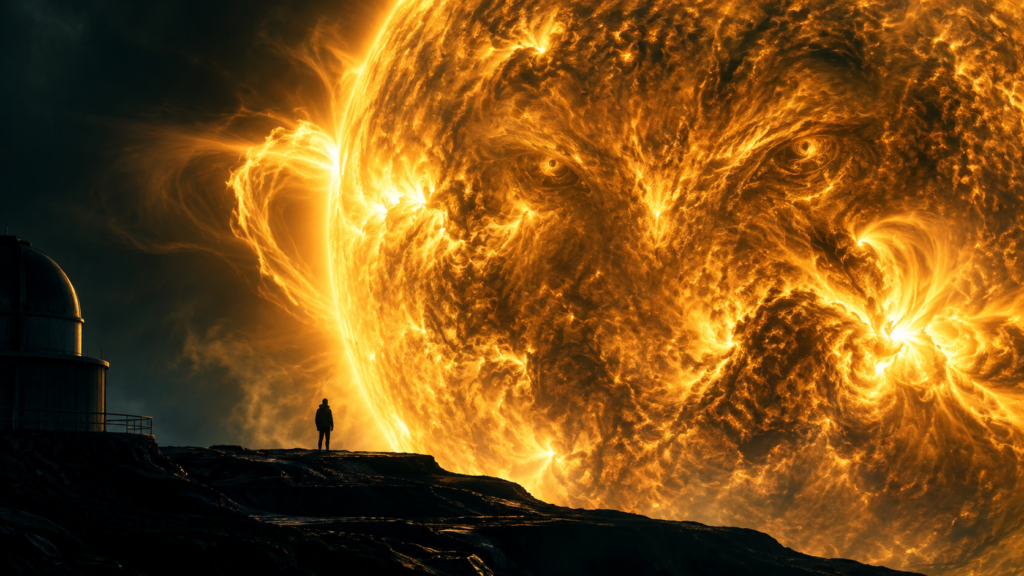
This article is adapted from a deeper free Meruqel eBook that explores the same question in greater detail. The full investigation examines the Sun through the lenses of science, ancient belief, consciousness, and the possibility that humanity may be using definitions of life and awareness that are far too narrow.
We think we know what the Sun is. Science can describe its structure, its fusion process, its magnetic fields, its cycles, and the enormous amount of energy it releases into space. Yet describing how something works is not always the same as understanding what it is. That leaves a strange possibility worth considering: what if the Sun is not alive in the biological sense, but is still something we would have to call a being?
We May Be Using the Wrong Definition of “Being”
When we ask whether the Sun is alive, the question seems easy to answer. Biological life, as we understand it on Earth, depends on things such as cells, metabolism, reproduction, and genetic information. The Sun does not fit that definition.
But the word “being” opens a different door. Must every being be biological? Must every form of awareness require a brain? Could consciousness exist inside physical systems that look nothing like animals, plants, or human nervous systems?
Those questions matter because our definitions are based almost entirely on the forms of life we already know. We recognize minds inside organisms because organisms are where we encounter minds. That does not necessarily mean biology is the only possible form in which awareness could exist.
The more interesting question, then, may not be whether the Sun is alive. It may be what kinds of things are capable of possessing awareness, identity, or some form of inner experience.
The Sun Is Far Stranger Than It Looks
From Earth, the Sun can appear simple: a bright sphere crossing the sky. In reality, it is an enormous and highly dynamic system composed of plasma, magnetic fields, convection, oscillations, rotating regions, solar cycles, eruptions, and interacting processes operating across vast scales.
None of this is evidence that the Sun is conscious. Complexity alone does not prove awareness. But it does remind us that the Sun is not a simple object.
There is also an uncomfortable gap in human knowledge. We understand nuclear fusion far better than we understand consciousness. We can explain many of the physical processes occurring inside a star, yet we still do not have a universally accepted explanation for why physical matter can produce subjective experience at all.
That creates a legitimate philosophical mystery. If we still do not fully understand what consciousness is or what produces it, how confidently can we declare where consciousness cannot exist?
Humanity Has Treated the Sun as a Presence for Thousands of Years
Ancient cultures repeatedly treated the Sun as more than a source of heat and light. Across different civilizations, it was described as a deity, ruler, observer, giver of life, or conscious presence. Ra appeared in ancient Egypt. Surya held an important place in Hindu tradition. Inti was central to Incan religion. Helios crossed the Greek sky, while Amaterasu became one of the most important figures in Japanese tradition.
There is an obvious explanation for this. The Sun determined survival. It governed crops, seasons, warmth, daylight, and the rhythms of everyday life. Human beings naturally personified forces that seemed powerful, mysterious, and essential.
Still, the pattern remains intriguing. Across cultures separated by geography and history, people repeatedly described the Sun not merely as powerful, but as something with presence, agency, or awareness.
That does not prove the Sun is conscious. It does raise an interesting question about why humanity so consistently imagined that it might be.
Perhaps the Real Mystery Is Consciousness
We tend to assume that consciousness belongs to brains because brains are where we experience it. Yet that assumption may tell us more about human experience than about the universe as a whole.
If consciousness can exist in forms radically different from human consciousness, a star would represent one of the strangest possibilities imaginable. Any hypothetical form of stellar awareness would operate on scales of size, energy, and time almost impossible for a human mind to intuitively understand.
The Sun is billions of years old. Processes occurring within it unfold over timescales that dwarf a human lifetime. If some form of awareness did exist in a system like that, it might be so slow, distributed, or unfamiliar that we would not recognize it as awareness at all.
The greatest obstacle to recognizing an unfamiliar kind of being may be our expectation that a being should resemble us.
A Larger Question
There is no scientific evidence demonstrating that the Sun is conscious, and it is not biologically alive in any conventional sense. But the question itself exposes something far more important. Humanity still does not know exactly what consciousness is, where it begins, or what forms it may be capable of taking.
Perhaps the mystery of the Sun is not really about the Sun. Perhaps it is about the limits of the categories we use to understand reality.
This article is only an excerpt from the deeper Meruqel investigation, Is the Sun a Being? The free PDF goes further into stellar science, ancient solar traditions, consciousness, the possibility of stellar intelligence, and the broader question of whether the universe may contain forms of being we have never learned to recognize.
Read the complete investigation free: Is the Sun a Being?