
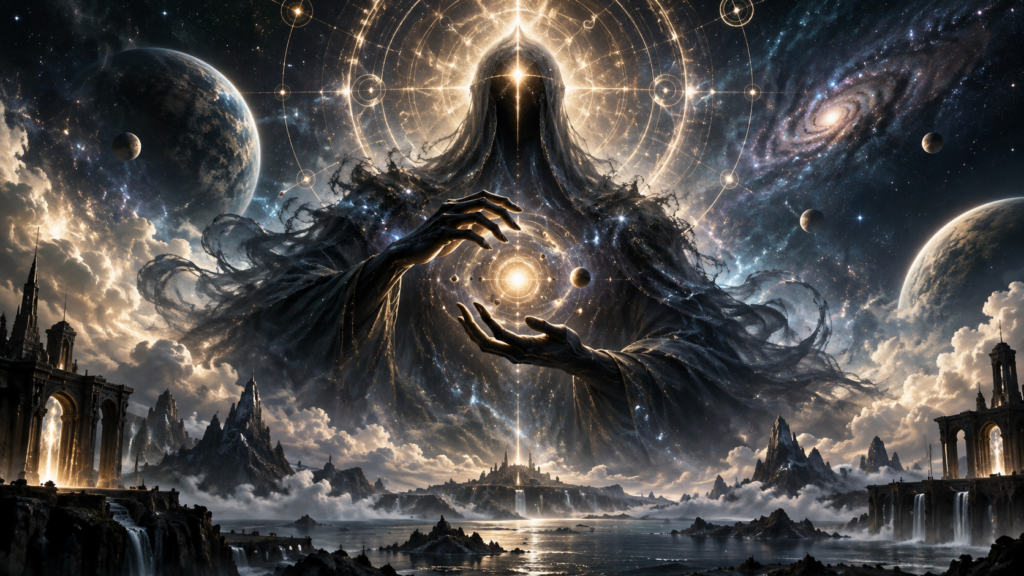
For most of human history, people have believed that higher intelligences exist beyond ordinary human beings. We called them gods, angels, spirits, celestial beings, divine messengers, ancestors, watchers, and creators. The names changed from culture to culture, but the central idea remained remarkably persistent: humanity was not alone, and something greater than us was involved in the story.
That idea becomes much more interesting when we stop assuming that every being called a “god” had to be God in the ultimate sense. Ancient people encountered the unknown using the language available to them. A being that descended from the sky, possessed extraordinary knowledge, demonstrated abilities beyond human understanding, or claimed involvement in the creation of humanity would naturally be described in supernatural terms. To an ancient observer, advanced intelligence and divinity could have looked almost identical.
This creates a fascinating possibility. Some ancient stories traditionally classified as mythology or religion can also be read as descriptions of encounters with forms of intelligence that human beings did not understand. Mesopotamian traditions described powerful beings connected to the heavens. Egyptian civilization filled its sacred history with gods who taught, ruled, created, judged, and transformed human life. Greek mythology described beings with extraordinary powers who interacted directly with humanity. Similar patterns appear across cultures that developed thousands of miles apart.
The connection does not end in antiquity. Modern culture now uses completely different language for extraordinary intelligence. We speak of extraterrestrials, nonhuman intelligence, interdimensional beings, artificial superintelligence, advanced civilizations, and forms of consciousness that exist beyond the human brain. The vocabulary has changed, but the mystery underneath it has not. We are still trying to describe intelligence greater than our own.
And this is where the old stories suddenly become relevant again. Imagine an advanced nonhuman civilization visiting Earth thousands of years ago. Its technology would not need to violate the laws of nature to appear supernatural. Flight would look miraculous. Advanced medicine could resemble resurrection. Genetic manipulation would appear to be creation itself. Communication across great distances could resemble telepathy. Knowledge of astronomy, engineering, or natural forces would place such beings far beyond the capabilities of the people observing them.
Arthur C. Clarke famously captured the basic problem when he observed that sufficiently advanced technology becomes indistinguishable from magic. Apply that idea to the ancient world and another possibility emerges: sufficiently advanced intelligence becomes indistinguishable from divinity.
This does not mean every ancient god was an extraterrestrial visitor or every religious story hides a technological encounter. The deeper point is more disruptive. The category of “god” can conceal many different kinds of beings. Humanity has traditionally placed creators, cosmic intelligences, supernatural entities, advanced visitors, spiritual beings, and the ultimate source of existence into overlapping categories. They do not necessarily belong together.
That distinction changes the question completely. Instead of asking whether ancient gods existed exactly as religion described them, we can ask what kind of intelligence inspired the stories in the first place. We can ask whether humanity encountered something real and interpreted it through the worldview of the time.
The universe is enormous, ancient, and filled with possibilities that human civilization has barely begun to explore. If higher intelligence exists in forms radically different from our own, humanity may have encountered it before without possessing the language to recognize what it was.
Perhaps the greatest mystery is not whether the gods were real. It is whether we ever understood who—or what—we were dealing with.
Want to go deeper? Continue exploring inside the course.