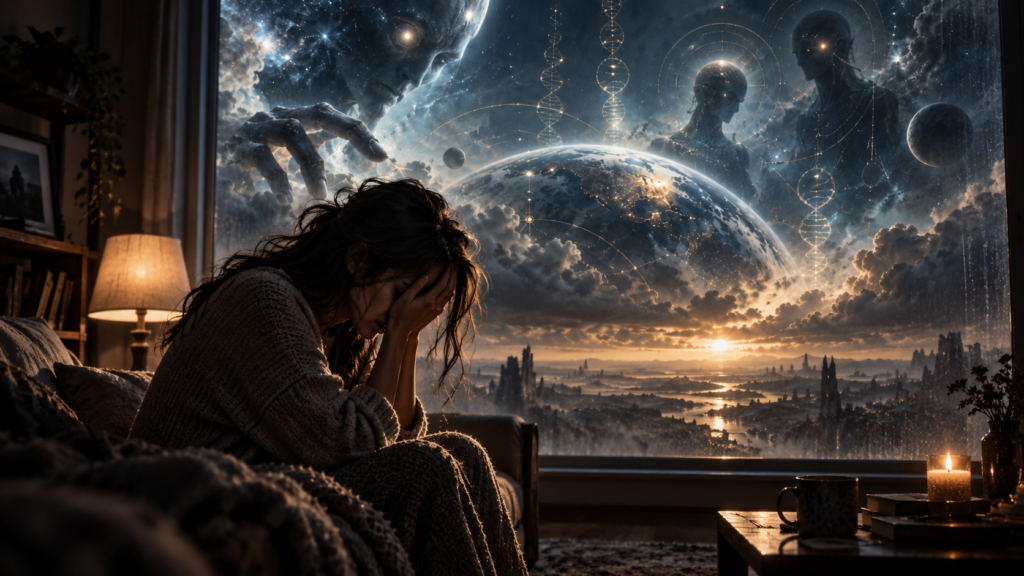
If humanity was created, engineered, altered, or guided by an intelligence greater than our own, one question becomes impossible to ignore: why would our creators allow us to suffer? Human history is filled with war, disease, famine, violence, natural disasters, childhood illness, and tragedies that often appear random and deeply unfair. If another intelligence played a role in bringing humanity into existence, its apparent willingness to permit suffering becomes one of the greatest mysteries surrounding our origins.
For centuries, religion and philosophy have approached this problem from a particular assumption: the creator is God. In that framework, the creator is all-powerful, all-knowing, morally perfect, and ultimately responsible for existence itself. Once those qualities are assumed, suffering becomes a profound contradiction. If the creator is perfectly good, why permit terrible suffering? If the creator is all-powerful, why not prevent it?
This is the classic problem of evil. Yet there may be another way to approach it. Perhaps the contradiction becomes so difficult because we begin by assuming that anyone capable of creating humanity must also be divine.
Creation Does Not Automatically Mean Divinity
Human beings create things constantly, and creation does not require perfection. Scientists manipulate genes, engineers build complex machines, programmers create artificial environments, and parents create children. None of these creators controls every outcome that follows from creation. None is all-knowing, and none can guarantee that what they create will remain free from suffering or failure.
Creation therefore does not automatically imply unlimited power, perfect knowledge, or moral perfection. It simply requires sufficient ability to bring something into existence, alter it, or set a process in motion.
When we think about humanity’s origins, however, we often abandon this distinction. If another intelligence created or modified us, we tend to assume that intelligence must be God. Yet a civilization thousands or millions of years more advanced than our own could possess abilities that would appear miraculous without being supernatural.
Such beings might understand genetics, biology, consciousness, or planetary systems at levels far beyond human science. To an ancient population, their abilities could easily have appeared divine. But appearing divine is not the same as being divine.
An advanced intelligence could be extraordinarily powerful while still being limited. Its members might make mistakes, disagree with one another, operate under constraints, abandon projects, or choose not to intervene in every consequence of their actions. Once that possibility is allowed, the relationship between creation and suffering changes.
Perhaps Our Creators Would Not Think Like Parents
Human beings often imagine creators as cosmic parents. We assume that if another intelligence created us, it must want us to be happy, safe, and protected from pain. We further assume that a creator who permits suffering must either be cruel or nonexistent.
But creation does not necessarily imply parenthood. A scientist who creates or modifies an organism may care about the outcome without protecting that organism from every hardship. An engineer may build a complex system without intervening whenever one component fails. The purpose of creating something may be very different from the purpose of nurturing every individual within it.
Nature itself gives us little reason to believe that comfort is the central principle of life. Biological existence is shaped by adaptation, competition, reproduction, mutation, predation, environmental pressure, and death. Evolution does not prioritize the happiness of individual organisms. It favors survival and adaptation.
This does not prove that humanity was created by an outside intelligence, but it raises an important possibility. Even if creators exist, their goals may have little to do with protecting us from suffering.
Humanity could have been created or modified as part of a biological experiment, a consciousness project, an evolutionary intervention, a colonization effort, or something we do not yet have the concepts to understand. If so, suffering might not contradict the purpose of creation at all. It might simply reveal that the creators’ objectives were different from the ones we assumed they must have.
Free Will May Not Explain Everything
One traditional explanation for suffering is free will. Human beings must be allowed to make genuine choices, and genuine choice allows selfishness, cruelty, and violence. That may account for some suffering, but it does not easily explain earthquakes, genetic disorders, childhood cancers, infectious diseases, or other tragedies unrelated to human decisions.
If creators are not gods, other explanations become possible. They may be able to influence life without controlling every event within it. They may know far more than we do without knowing everything. They may have started a biological or evolutionary process that now operates largely according to natural laws. They may also choose not to interfere continuously because intervention could undermine whatever purpose the system was designed to serve.
None of these possibilities proves that such creators exist. What they reveal is that the entire philosophical problem changes once we stop treating “creator” and “God” as interchangeable ideas.
A creator could be powerful without being all-powerful, knowledgeable without being all-knowing, and responsible for our existence without being morally perfect. Beings with such abilities could have appeared divine to ancient humanity while remaining something very different from gods.
This question becomes much stranger once we stop assuming that creators must also be gods. Once that assumption is removed, new possibilities emerge concerning human origins, ancient religious traditions, the beings described as gods, and the reason suffering could exist within a created world.
The free Meruqel mini-book WHY CREATORS DON’T HAVE TO BE GODS explores that distinction in greater depth. It examines why creation does not necessarily imply divinity, how advanced beings could have been interpreted as gods, and how the question of human origins changes once we separate the idea of a creator from the idea of God.
Download the free eBook “WHY CREATORS DON’T HAVE TO BE GODS” in the Meruqel Store.